

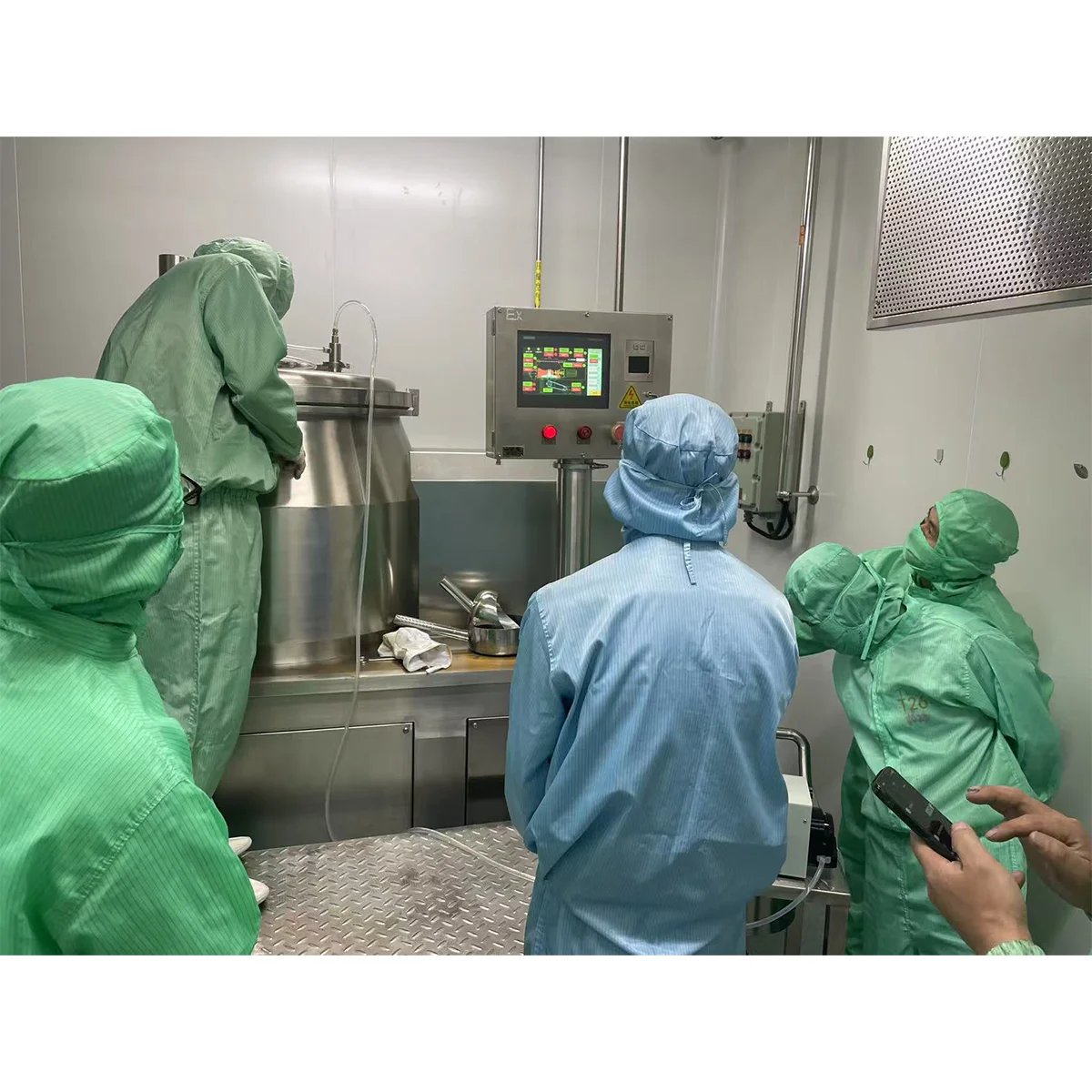
Introduction: This photo shows our team at a pharmaceutical plant site in Guizhou, Yunnan. Workers are wearing full dustproof suits and standing on stainless steel frames to calibrate touchscreens. This is not for show; it is the most critical “airtightness and high-level automation testing” for drying equipment.
Many in the industry have a bad habit of thinking that a dirty environment during machine installation is acceptable, as long as the dust collection system is online before official production begins. This mindset can be fatal. During the debugging and commissioning phase, if even a small amount of dust enters the sealed system, serious problems will arise later.
Why Must Drying Equipment Installation Include Dust-Free Airtightness Testing?
If the dust collection system is not activated in advance during equipment installation, trace amounts of dust can easily invade sensitive sensors and pneumatic valves. This results in frequent automation process crashes due to data errors.
Furthermore, residual dust subjected to long-term heat within a sealed high-temperature drying chamber will deteriorate and undergo coking. Once this leads to foreign matter exceeding standards in the product, the economic loss from scrapping the entire batch will be dozens of times the cost of dust-free testing.
Modern equipment demands high precision and is filled with sensitive sensors and pneumatic valves. Once dust gets stuck inside, sensor readings can easily become distorted. Consequently, automated processes are prone to triggering faults and errors due to data distortion, leading to downtime.
Manufacturers spend significant capital on automated equipment, only to end up arranging manual labor for daily troubleshooting.
Even worse are the subsequent maintenance costs. Trace particles trapped in a sealed high-temperature drying chamber will deteriorate and coke over time. For pharmaceutical or food processing, this directly crosses food safety red lines. If a single batch is found to have foreign matter exceeding standards, the loss from scrapping the entire batch is absolutely dozens of times the cost of performing proper dust-free testing initially.
To put it bluntly, if you prioritize speed and convenience during on-site debugging, you are gambling with product yield and food safety.